
When an iPhone slips from a nurse’s hand during medication administration or tumbles off a workstation cart, the consequences extend beyond a cracked screen. Clinical workflows stall, patient data becomes temporarily inaccessible, and the hospital incurs unplanned expenses that strain already tight IT budgets.
So, what happens when mobile devices hit hospital floors? We’ll walk through drop-test standards, real-world cost data, and research on device failures to show the actual cost of device drops and how they can be avoided. The good news is that device protection is easier and closer than most healthcare organizations realize.
The Reality of Device Drops in Healthcare Environments
Hospital environments present a uniquely hostile landscape for consumer mobile devices. Devices are passed between hands during shift changes, balanced on equipment carts rolling over uneven floors, and used in fast-paced clinical settings where a secure grip is the last thing on a clinician’s mind. Research suggests that replacing devices costs around $3,000 per item. For a 300-bed hospital, that translates to $1–$2 million in annual replacement costs!
The drop surfaces in hospitals are punishing, with no carpet or plush furniture anywhere in sight. To prevent the spread of disease and facilitate easy cleaning and sanitizing, hospital floors are typically hard tile, polished concrete, or terrazzo.

Understanding Drop Test Standards: MIL-STD-810G
When evaluating device protection, the standard you’ll most often encounter is MIL-STD-810G, a U.S. Department of Defense specification that includes 29 test methods for environmental durability. For drop protection, Method 516.6, Procedure IV (the Transit Drop Test), is the relevant benchmark.
What MIL-STD-810G 516.6 Actually Tests
The standard requires a device to survive 26 sequential drops from 48 inches (4 feet) onto 2-inch plywood backed by concrete. The device must be dropped onto each face, edge, and corner, then inspected after each drop for structural and functional integrity.
How Beam Mobile Tests Device Cases
While MIL-STD-810G provides a useful baseline, there is no governing body that regulates how the tests are performed. This is one reason Beam Mobile is transparent about the tests we perform and the results, regardless. As any healthcare professional knows, devices in hospital settings regularly fall from counters (3–4 feet) and from elevated surfaces such as IV poles, wall-mounted docking stations, and even multi-story atriums. A proper heavy-duty case should withstand drops from at least 6 feet onto hard surfaces.
That’s precisely what we did at Beam. We conducted tests in accordance with the general standards, then increased the height to 6 feet for subsequent tests to confirm our case’s durability.
The True Cost of Unprotected Devices
The financial impact of device damage extends well beyond the cost of a replacement phone or a screen repair. Healthcare organizations need to consider the full cost picture.
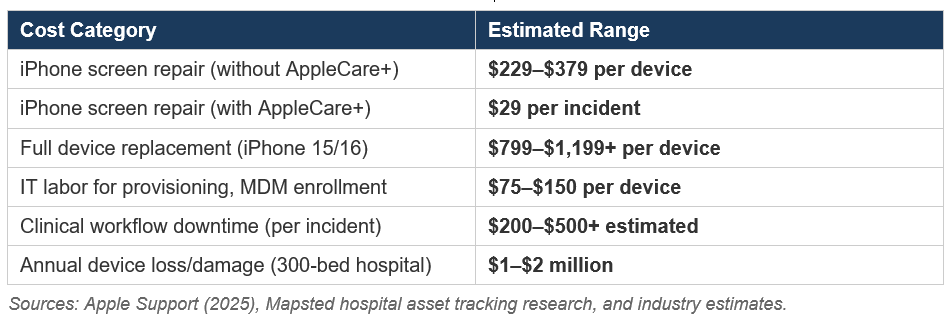
Hidden Costs That Multiply
When a nurse’s device breaks mid-shift, the ripple effects include time spent searching for a replacement device, relogging into EHR systems with multi-factor authentication, potential gaps in medication scanning and barcode verification, and increased infection risk from device sharing. These disruptions compound across large nursing staffs and 24/7 shift rotations.
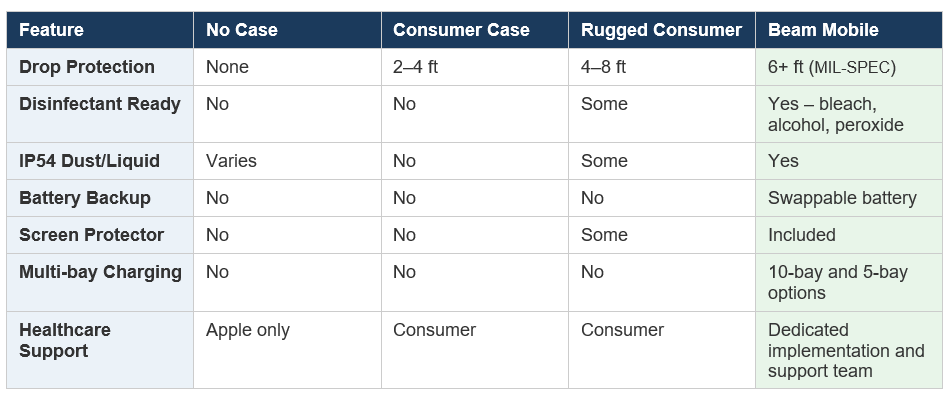
Consumer vs. Healthcare-Grade Device Protection
Most consumer devices are not built to withstand the unique demands of healthcare systems. When considering device protection for a large organization, you have a few options.
The ROI of Beam Device Protection
Healthcare leaders invest in countless pieces of equipment; it’s time to start protecting those investments and mitigating more costly risks later on.
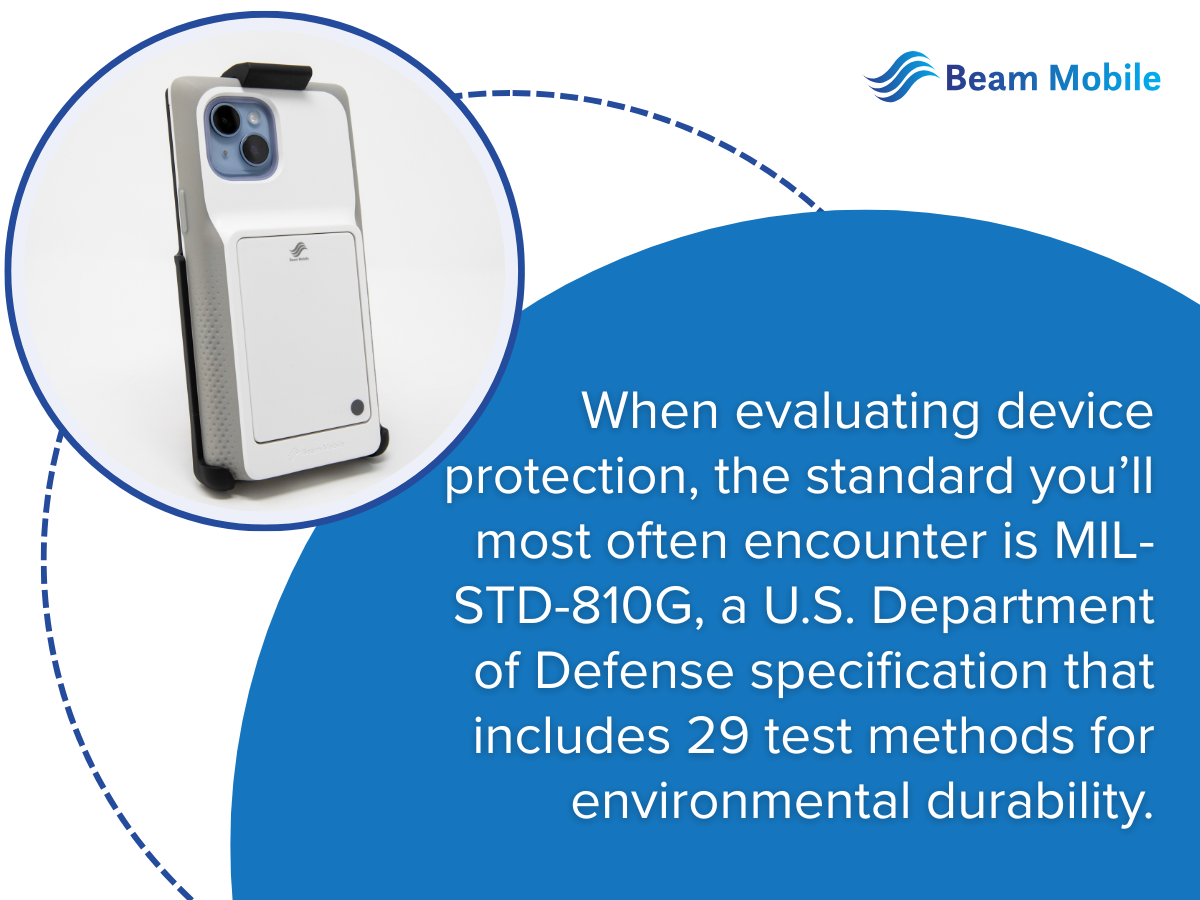
Beam cases deliver proven MIL-SPEC810G drop protection, IP54 sealing against cleaning solutions, and swappable batteries that extend device life, enabling uninterrupted workflows. Given that hospitals typically replace iPhones every three years, consistent drop protection and proper battery management through Beam’s swappable battery system can help ensure devices remain functional and reliable throughout that lifecycle, reducing the risk of premature replacements.
Mobile Device Protection Is a Clinical Decision
Beam’s goal has always been to ensure our device protection meets and exceeds the demands of clinical environments, including hard floors, aggressive disinfectants, 12-hour shifts, and constant handling.
Beam was purpose-built for healthcare, featuring:
- MIL-SPEC810G drop-rated
- Disinfectant-ready polycarbonate construction
- IP54 dust and liquid protection
- Integrated screen protectors
- Swappable batteries
- Holsters and VESA-compatible mounts available
Request a free eval to test Beam’s protection in your clinical environment.